

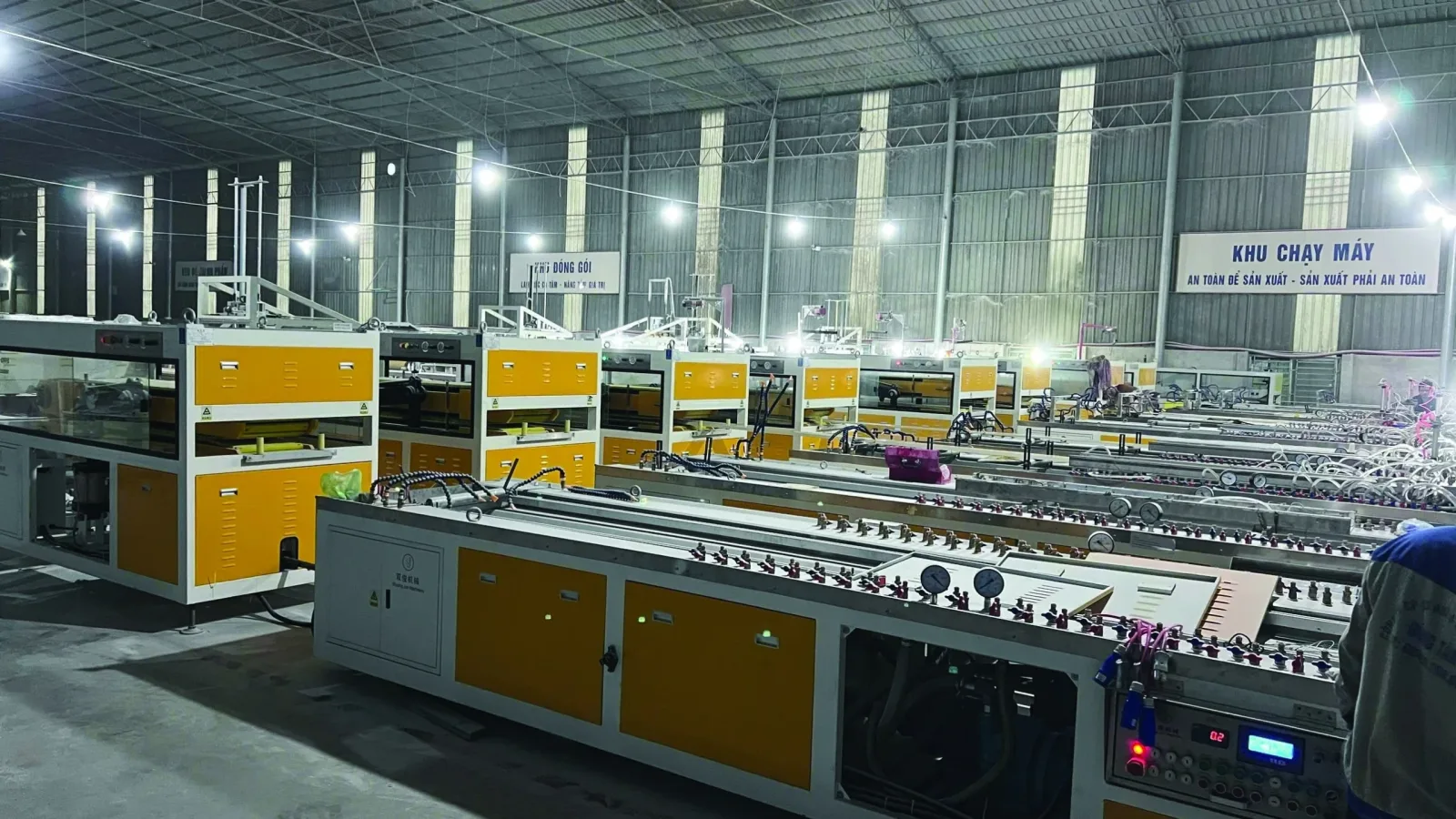
PVC wall panels are made in four connected stages. A plant blends a compound, extrudes it into a profile, laminates a decorative film onto the face, then inspects and packs the result. That much fits in a sentence. What it hides is that almost every quality difference between two panels traces back to a decision inside one of those stages.
So this guide walks the process in order, and points out where a plant wins or loses consistency at each step. It comes from a production floor rather than from a brochure, because we run 25 extrusion lines ourselves. If you want the product explanation first, we cover panel structure and materials separately.
How are PVC wall panels made? The short answer
Extrusion is the core of it. An extruder takes dry compound into a heated barrel, softens it, and pushes it continuously through a shaped die. The profile that emerges holds that shape as it cools, and a saw cuts it to a fixed length further down the line.
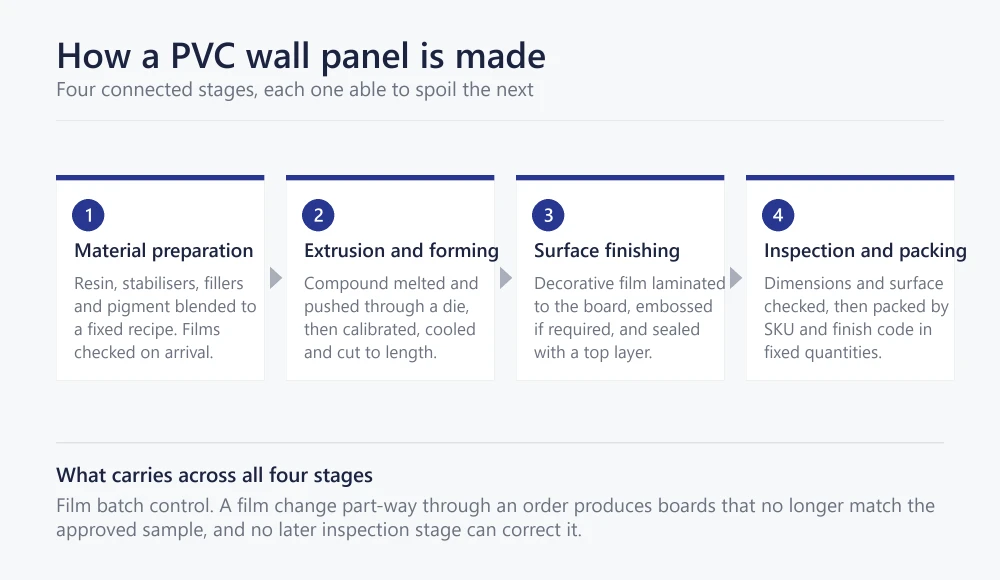
Everything else serves that step. Material preparation decides what the extruder can handle, lamination decides what the board looks like, and inspection decides what leaves the building. None of them can rescue a profile that came off the die wrong.
Stage one: the compound, not the resin
Raw polyvinyl chloride resin is a white powder, and on its own it is unusable. Producers blend it into a compound before anything reaches an extruder.
A typical blend includes stabilisers, which keep the polymer from degrading under processing heat; processing aids, which control how the melt flows; fillers, which add stiffness and bulk; impact modifiers; and pigment. Ratios are proprietary, and the international designation systems for PVC-U extrusion materials, such as ISO 21306-1, describe how the industry classifies such materials rather than what any one producer puts in them.
Two things at this stage decide more than most buyers realise. The first is consistency of the recipe between batches, since a compound that drifts produces boards that behave differently on the same wall. The second is incoming inspection. We buy substrate resin and surface films to specification and check them on arrival, because a defect accepted here travels through every stage that follows.
Stage two: how PVC wall panels are made on the extrusion line
The extruder itself is a heated barrel with one or two rotating screws. Compound enters at the hopper, and the screws convey, compress and melt it as it travels forward. Heat comes partly from barrel heaters and partly from the shearing action of the screws.
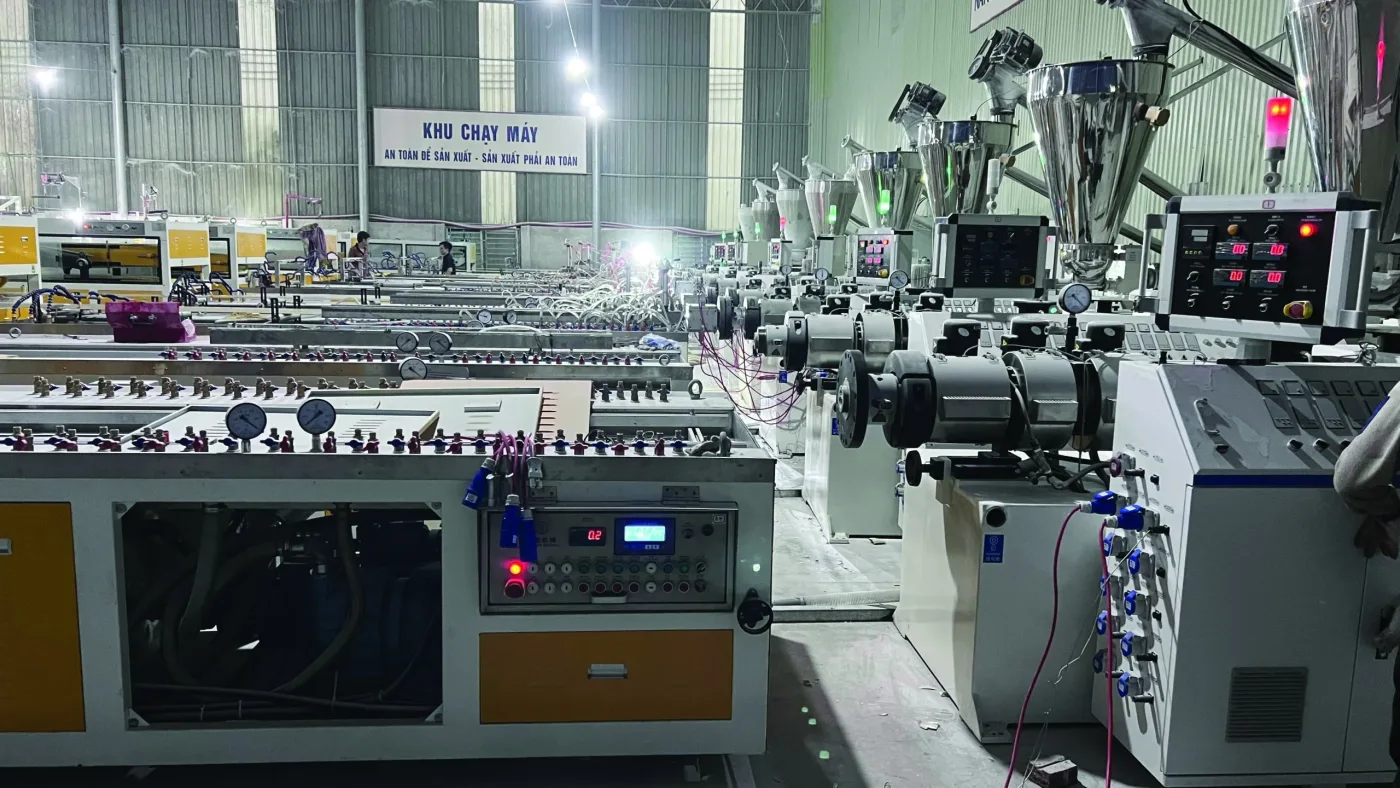
At the end of the barrel the melt passes through a die, which gives the profile its cross-section: the face, the back, the internal ribs and the tongue-and-groove edges all form here. The profile then enters a calibration unit, where vacuum and cooling water hold it against a shaped surface until it sets.
Calibration is the step that creates dimensional tolerance. A profile that leaves the die correctly but cools unevenly will bow, twist or vary in width, and nothing downstream fixes it. Line speed, melt temperature and cooling all have to stay within a narrow band, which is why an extrusion line runs continuously rather than in stops and starts.
A cut-off saw ends the sequence, taking the continuous profile down to a fixed length. Ours run at 3,000 mm for panels and 4,000 mm for box sections.
What the extruded section actually looks like
Cut a finished board across its width and the extrusion becomes legible. Internal ribs hold the two faces apart, which keeps the board light without making it flexible.
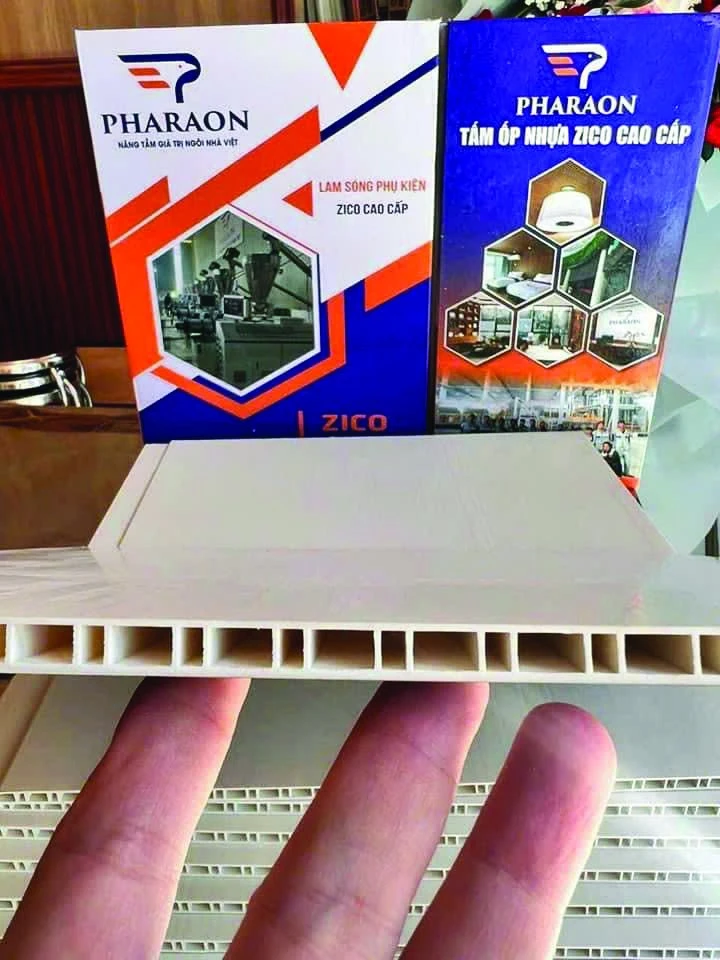
The die sets rib spacing, and no later step changes it. Closely spaced ribs support the face against denting but use more material. Widely spaced ribs are cheaper and lighter, though they leave a longer unsupported span between them. Neither is universally right, so ask for a section drawing rather than assuming. Our guide to choosing a specification covers how that choice reaches a project.
Stage three: lamination and the decorative film
An extruded board has no pattern. Everything a buyer eventually sees arrives in the next stage.
The board passes through a laminating line, where heated rollers bond a printed film to the face. Some products take an emboss at the same time, which presses a texture into the surface that registers with the printed grain. A clear top layer over the film takes the wear, because the print alone would not survive cleaning.
Film quality is where cheap panels usually give themselves away. A thin film shows the substrate colour through it; a poorly bonded one lifts at cut edges; a badly registered emboss produces a grain texture that does not line up with the printed grain. None of these is visible in a photograph, and all of them are visible on a wall.
Why trims have to run the same film
Panels are only part of an order. Corners, end caps, cornices, skirting and door casings all have to match, and matching means one film rather than two similar ones.
That is why our plant runs 15 offline finishing lines alongside the extrusion lines. Those lines laminate accessory profiles in the same films that run on the flat boards, so a cornice and the wall beneath it come from one finish code. A supplier who sources trims separately can offer a near match, and a near match is exactly what the eye reads as a defect. The full range sits under trims and mouldings.
Stage four: inspection, packing and release
Quality control runs across all four stages rather than sitting at the end, and the reason is arithmetic. A deviation caught at incoming material costs a batch. The same deviation caught at dispatch costs a shipment.
Our process has four checkpoints: incoming material inspection, production monitoring at key stages, finished product inspection before release, and a feedback loop that returns operational and customer findings to the process. Our team then picks finished goods by SKU and finish code in fixed pack quantities, which is what allows a distributor to reorder against a code months later.
Packing matters more than it sounds. Corner protection, consistent pack counts and clear finish labelling determine whether a board arrives usable, and they say a good deal about how a supplier handles goods generally.
Where PVC wall panels are made, and why the plant matters
Production capacity is not vanity. It decides whether a supplier can take a second order without delaying the first.
Our plant at Phu Xuyen in Hanoi runs across a 16,000 m² site in four workshops. It holds 25 nano extrusion systems, one stone-grain PVC extrusion line and 15 offline lamination lines, with a sustained output of about 1,700 m² per machine per day and a rated annual output of 62,000 tonnes for 2025. Machine count has risen every year since 2022, from six lines to twenty-five.
Those figures matter to a buyer in one specific way. Capacity headroom is what lets a manufacturer produce a whole project order in a single film batch rather than splitting it across two runs months apart. Full detail sits on our factory page.
Where wood-plastic composite differs on the line
Not every board on the market runs the same compound, and the difference shows up at the extruder rather than on the sample.
A mainly mineral-filled PVC compound is the simpler of the two to run. It melts predictably, tolerates a wider processing window and holds dimension well through calibration. A wood-plastic composite behaves differently, because wood flour absorbs moisture and moisture turns to steam at processing temperature. That forces a drying step before extrusion and a narrower temperature band during it.
The pay-off is stiffness and a denser feel in the hand, which is why several of our formats use it. Our own product certificate under TCVN 11353:2016 covers a film-laminated wood-plastic composite decorative board, so the certified scope names the material rather than leaving it to a description.
For a buyer the practical point is narrow. Ask which compound a given format uses, because the answer changes how the board takes a fixing and how it behaves against a plasterboard ceiling. It also explains why two panels of the same thickness can weigh noticeably different amounts, a difference we cover in interior cladding applications.
Where consistency actually comes from
Ask a supplier how they guarantee consistency and the answer usually mentions inspection. Inspection is the last line, though, not the first.
Consistency comes from three earlier things. It comes from a compound recipe that does not drift between batches. It comes from an extrusion line held at stable temperature and speed, since calibration creates dimensional variation and no later step corrects it. Above all, it comes from film batch control, because a film change part-way through an order produces boards that no longer match the approved sample, and no inspection stage can undo that.
We control film batches deliberately for that reason. It is also why we recommend ordering a whole project quantity at once rather than topping up later.
What a buyer can verify about how PVC wall panels are made
Most buyers will never see the line, so the practical question is what can be checked from outside.
- Ask for the machine count and the workshop area. A manufacturer knows both immediately. A trader usually does not.
- Ask how film batches are controlled across a phased order. The answer separates people who have thought about it from people who have not.
- Ask which quality-control stages exist by name. Four named checkpoints beat a general assurance about quality.
- Ask for the product certificate and the test reports in full. Check the certified dimensions, not only the standard number. Ours are published on the certifications and test reports page.
- Ask whether the plant hosts buyer audits. Ours does, and a supplier who declines has told you something.
One honest note on environmental claims. We run the extrusion process for energy efficiency and recover offcuts, but we do not currently publish third-party environmental certification. If that matters to your project, ask any supplier for the certificate rather than accepting the adjective.
Frequently asked questions
How are PVC wall panels made?
We extrude them. An extruder melts a PVC compound and pushes it through a shaped die. Calibration and cooling then fix the profile, a saw cuts it to length, a laminating line adds the decorative film, and inspection follows before packing.
Are PVC wall panels made from pure PVC?
No. The compound includes stabilisers, processing aids, fillers, impact modifiers and pigment alongside the resin. Some products also use a wood-plastic composite, where wood flour joins the polymer.
What decides a panel’s dimensional accuracy?
Calibration and cooling immediately after the die. A board that cools unevenly bows or varies in width, and no later stage corrects it.
Is the pattern printed or painted on?
Neither. A laminating line bonds a printed film to the board under heat and pressure, and a clear top layer then protects it.
Why do two panels in the same colour sometimes differ?
Usually a film batch change. A printed film repeats exactly within a production run, whereas two runs months apart can differ slightly under the same code.
Can you produce panels under our own brand?
Yes. Own-brand and neutral-packaging supply is part of our normal business, and it is easiest to arrange at specification stage.
Final thoughts
PVC wall panels are made well or badly at the extruder, not at the inspection table. The compound sets what is possible, calibration sets the dimensions, the film sets the appearance, and inspection only confirms what those three already decided.
For a buyer, that has one practical consequence. Questions about production capability tell you more than questions about the finished board, because the board is a result rather than a cause. A supplier who can describe their own line, name their control stages and explain how they hold a film batch across a phased order is telling you what their panels will be like long before a sample arrives.
If you want to see the scale behind it, our factory page sets out the plant, or talk to our team about a project.