

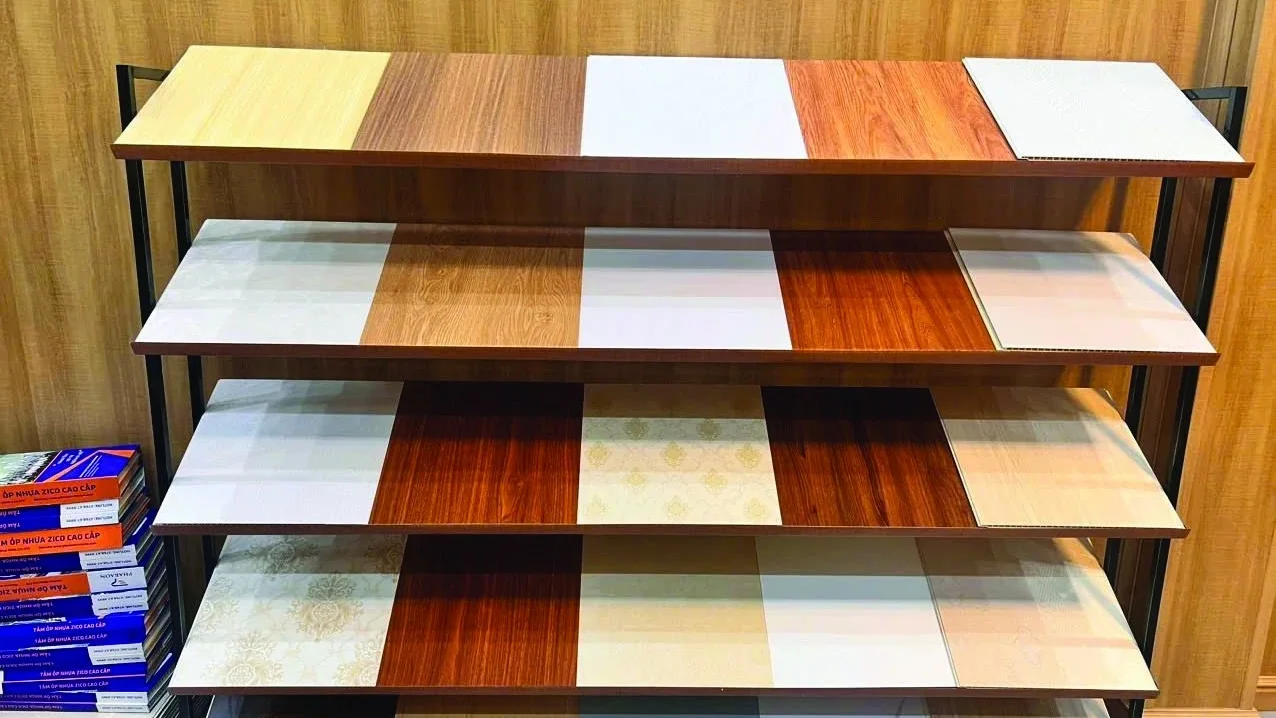
Knowing how to choose PVC wall panels is mostly a matter of taking the decisions in the right order. Buyers who start from a finish photograph usually end up reworking the specification later, because format, thickness and lighting all constrain which finishes actually make sense.
So this guide runs the decisions in the order that keeps them from colliding: room first, then format, thickness, flute depth, finish, trims and quantity. It finishes with the documents worth asking for before an order goes out. If you need the underlying product explanation first, our guide to what PVC wall panels are covers structure and materials.
We manufacture these panels, so the sequence below is the one our own technical team walks through with a specifier.
Start with the room, not the panel
Before you choose PVC wall panels for any space, four properties of the room rule options in or out. Settle them before anyone opens a sample book.
- Moisture. Dry interior walls are fine. Persistent damp, standing water and shower enclosures are not, so treat those zones as a separate specification.
- Direct sunlight. Any thermoplastic can move or shift colour under sustained direct sun. Our warranty excludes it, which makes unshaded south and west elevations a different problem.
- Impact. A trolley corridor or a loading route needs a thicker section, or a protection rail across the lower metre.
- Compliance. Escape routes and some public buildings carry a reaction-to-fire requirement. Establish it early, because it can eliminate a material rather than merely narrow it.
Only after those four pass does the rest of this article apply. Where the space fails one of them, no amount of specification detail rescues it.
Step one: choose PVC wall panels by format
Format has more visible consequence than any other decision, because board width sets how many joints the finished wall shows.
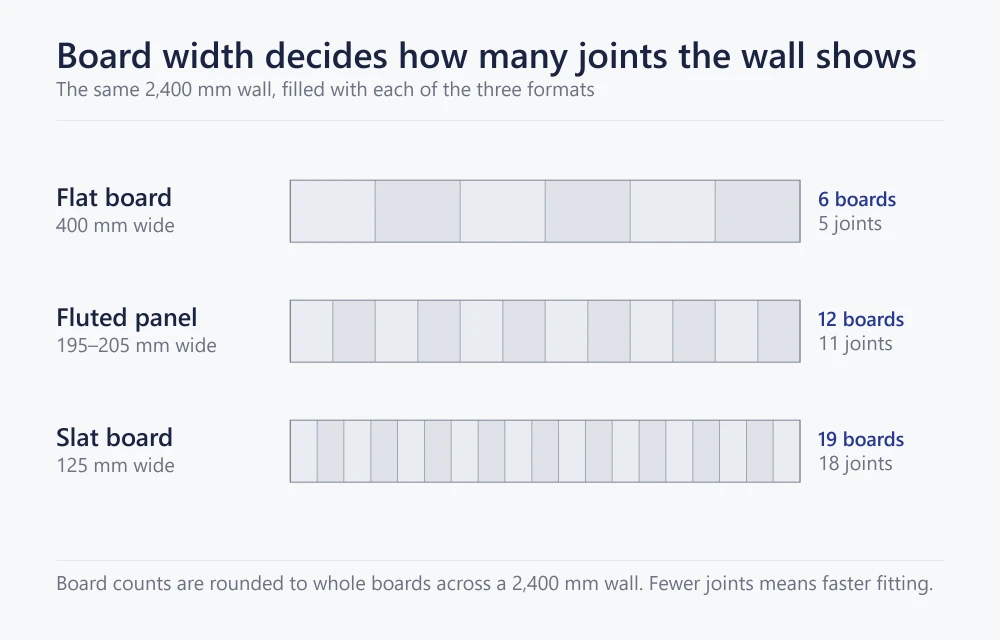
Broadly, flat 400 mm boards give the fewest joints, which makes them the default for large fields, ceilings and any surface meant to read as one plane. Fluted panels at 195 to 205 mm bring their own texture, so they suit feature walls rather than whole rooms. Slat boards at 125 mm produce the finest rhythm and the most joints, and they work best where the same linear language runs across walls, ceilings and joinery.
One practical note: fewer joints also means faster fitting. On a large commercial area that difference shows up in the programme, not only in the appearance.
Step two: thickness, and what actually decides it
Thickness is the least contentious decision when you choose PVC wall panels. Our flat boards come in 8 mm and 9 mm, and the honest answer is that most interior walls take either.
Weight is the real differentiator, and how the boards are made explains why. The 9 mm board runs 5.5 kg per square metre, and the 8 mm board is heavier at 7 kg per square metre. That sounds counterintuitive until you remember that thickness and density are separate variables, and the 9 mm profile carries more of its section as hollow chamber. On a plasterboard ceiling the lighter board is therefore the safer specification.
So choose the thicker section where the wall takes knocks, and the lighter one where the substrate carries the load. Beyond that, do not overthink it.
Step three: flute depth against the lighting
Flute depth only matters if light can reveal it. A deep 22 to 27 mm profile throws a hard shadow line under grazing light from a cove or a window, whereas the same board under flat frontal downlighting looks much like a low flute costing less.
Our guide to what PVC fluted wall panels are explains how the profile geometry produces that shadow. So check the lighting drawing before choosing depth, not afterwards. Our guide to interior cladding space by space works through how light behaves in each room type.
Step four: choose PVC wall panels by finish
We produce 32 surface finishes under the ZICO name, and they divide into families that behave differently at scale.
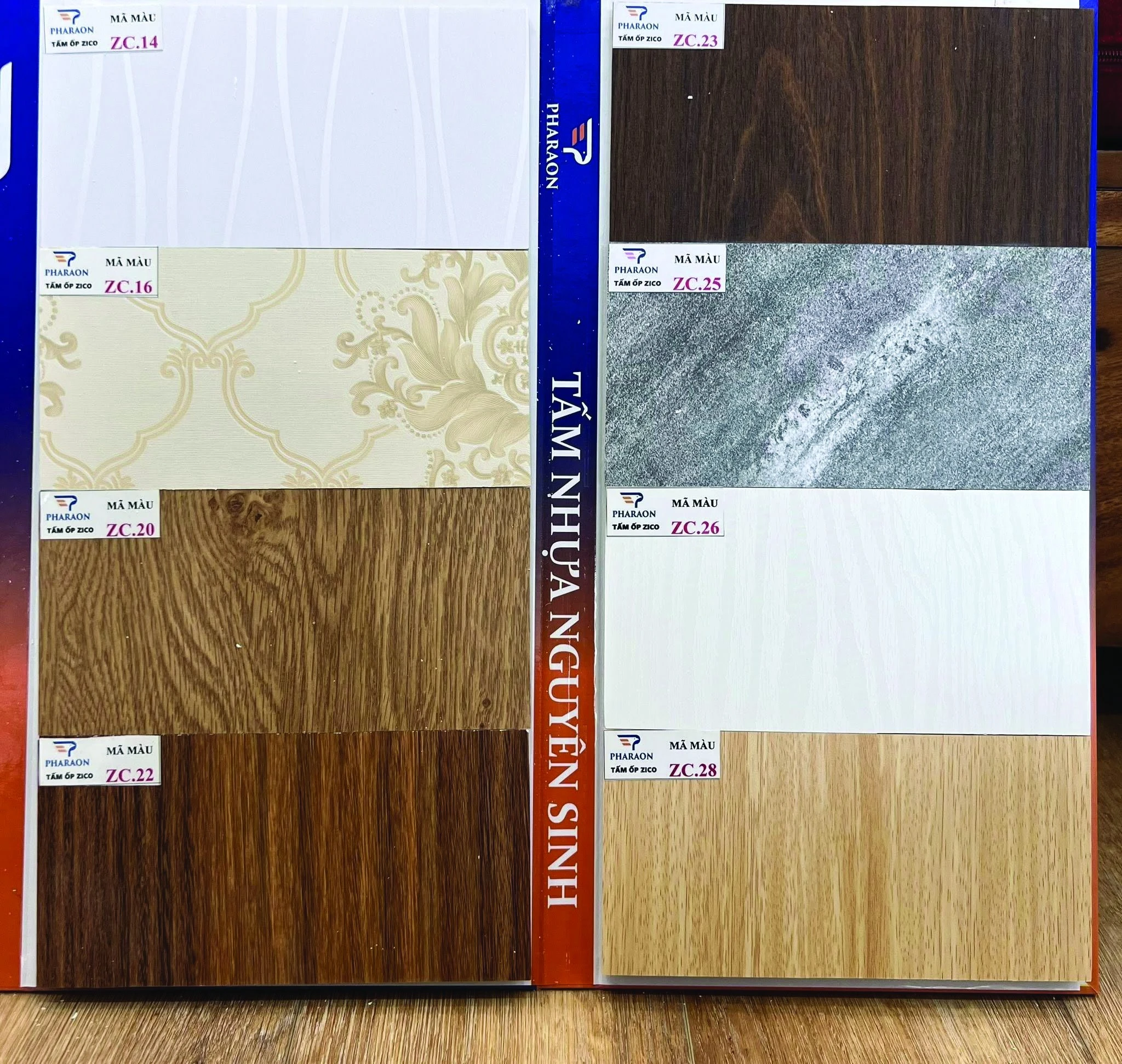
- Woodgrain. The largest family. Long, quiet grains scale up well, while high-contrast figures announce their repeat sooner.
- Stone and marble. Dramatic veining looks striking on a sample and repetitive across a long wall, so reserve it for smaller fields.
- Linen and textile. Effectively repeat-free at normal viewing distance, which makes these the safe choice for very large areas.
- Plain and classic. Plain colours sidestep repeat entirely. Classic patterned films suit traditional schemes and ceilings.
Finally, always specify by finish code rather than by name. Descriptions such as “light oak” mean different things to different people, whereas a code such as ZC.21 identifies one production film. That single habit removes most colour disputes on delivery.
Step five: match the trims
Trims are part of the specification rather than an afterthought at the end of it. A panelled wall has edges at floor, ceiling, corners and stops, and each one needs a profile.
The critical requirement is the film, not the profile shape. A trim in a near-match finish looks worse than a deliberate contrast, because the eye reads a near miss as a defect. We laminate the accessory profiles on the same lines and in the same films as the boards, so specify the trims and the panels with the same finish code and in the same order. The range sits under trims and mouldings.
Working out how much to order
Quantity arithmetic is simple, yet getting it wrong is expensive, because a top-up order can land from a different film batch.
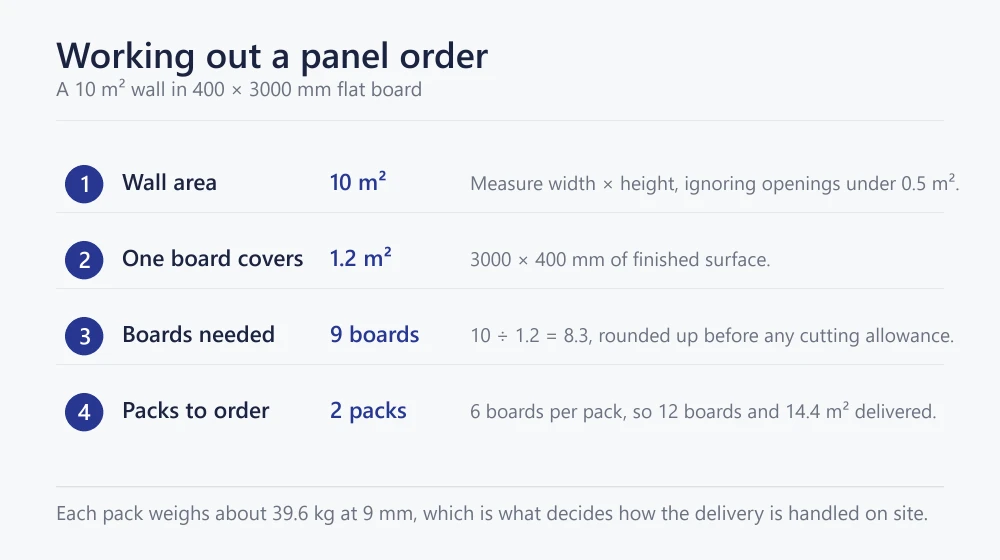
Add a cutting allowance on top of the calculated figure. Ten per cent covers a simple rectangular wall, and more suits a room with several openings, angles or a raking edge. Order the whole quantity at once, because film batch consistency is far easier to guarantee within one production run than across two. Allow for the cutting your installation method actually generates.
Full coverage and packing data for every product sits in the specification summary.
What a useful sample request looks like
Most sample requests are simply too small to tell a buyer anything. A single 200 mm offcut confirms the colour and nothing else.
Ask instead for three full boards drawn from different packs, in the finish code you intend to order, plus one length of each trim you will use. That set answers the questions a small sample cannot: whether the film repeats acceptably at scale, whether boards from separate packs match, and whether the trims genuinely share the film.
Once the samples arrive, our guide to evaluating panel quality sets out what to measure and what to look for under raking light.
The documents to ask for before you order
Documentation is the last stage when you choose PVC wall panels, and also the one most often skipped. It separates a manufacturer from a trader faster than any conversation about price.
- Product certification. Ask which standard, which certificate number, which certified dimensions and which validity period. A certificate covering one thickness does not automatically cover another.
- Test reports. Ask for the report itself rather than a summary. Check the laboratory, the test method and the date.
- Laboratory accreditation. A report carries more weight from a laboratory accredited to ISO/IEC 17025, since that accreditation covers the competence of the testing itself.
- Warranty terms in full. Duration alone tells you little. What matters is the remedy, the exclusions and who warrants installation as opposed to product.
- Packing and delivery data. Pack quantity, pack weight and pallet configuration decide how a site receives the order.
Ours are published rather than summarised, on the certifications and test reports page, so the scope can be checked against a project specification before anyone commits.
Where the budget actually goes when choosing PVC wall panels
Panels usually dominate the quantity, although they rarely dominate the risk. Most of the money sits in the boards, but most of the visible failures sit in everything around them.
Trims are the clearest example. They represent a small share of an order and a large share of how finished the wall looks, so cutting the trim budget to save a little rarely pays. Cutting allowance is the second example. Ordering exactly the calculated quantity looks efficient until one board splits during cutting, and then a single replacement board arrives from a different film batch.
Installation is the third. A panel system is only as good as its setting out, and a fitter working without a setting-out drawing will usually start from a corner and finish with a sliver at the most visible end. Budget the drawing time rather than discovering the problem on site.
Choosing PVC wall panels for a phased project
Hotels, apartment blocks and staged fit-outs need one more decision that a single room never does: how to keep floor twelve matching floor one.
Film batch is the variable that matters. A printed film repeats exactly within a production run, whereas two runs months apart can differ slightly even under the same code. Where a project runs across several deliveries, therefore, say so at quotation stage so the whole quantity can come from one film batch and be held rather than produced piecemeal.
Two practical habits help. Keep two or three spare boards per finish on site for later repairs, since a replacement from the original batch will always match better than a fresh order. Record the finish codes in the operations manual as well as the order, because the person repairing a damaged panel in year six will not have the purchase order.
A checklist to choose PVC wall panels
Everything above condenses into six lines. A specification that answers all six is ready to quote against.
| Decision | Options | Decide it on |
|---|---|---|
| Format | Flat 400 mm, fluted 195–205 mm, slat 125 mm, box section | Joint count and the visual effect wanted |
| Thickness | 8 mm or 9 mm flat board | Substrate load and impact exposure |
| Flute depth | 12–15 mm low, 22–27 mm deep | The lighting drawing, not the mood board |
| Finish | 32 ZICO codes across woodgrain, stone, linen, plain | Wall area and repeat behaviour at scale |
| Trims | 24 profiles: corners, caps, cornice, skirting, casings | Same finish code, ordered together |
| Quantity | Area ÷ coverage, rounded to whole packs | One order, with cutting allowance included |
Frequently asked questions
How do I choose PVC wall panels for a large project?
Work through format, thickness, flute depth, finish, trims and quantity in that order, then request three full boards from different packs before committing. Order the whole quantity in one production run.
Is a thicker panel always better?
No. Thickness affects impact resistance and weight, not finish quality. Our 9 mm board is actually the lighter of the two flat boards per square metre, so the thicker section is not automatically the heavier one.
How many finishes can one project use?
As many as the design needs, since all 32 finishes run across the flat, fluted and trim profiles. Combining two or three usually reads better than combining six.
What is the most common mistake when choosing PVC wall panels?
Choosing a finish from a small sample and discovering the repeat only once eight metres of wall are up. The second most common is ordering trims separately, in a film that nearly matches.
Can panels be ordered under our own brand?
Yes. Own-brand and neutral-packaging supply is part of our normal business, and it is worth raising at specification stage rather than after pricing.
How far ahead should an order be placed?
We confirm lead time against the actual order rather than publishing a fixed window, so ask for it in writing alongside the quotation.
Final thoughts
You choose PVC wall panels well by closing the decisions in an order that stops them fighting each other, not by hunting for the single best board. The room rules options out. Format sets the joint count. Thickness answers to the substrate. Lighting decides whether depth is worth paying for. Finish has to survive at full scale, and the trims have to come from the same film as the boards.
Get the sequence right and the specification writes itself. Get it backwards, starting from a photograph of a finish, and something usually has to be undone.
If a project is on your desk now, browse the full panel and trim range or talk to our team about a specification. We will tell you which options genuinely fit the space, and which ones do not.